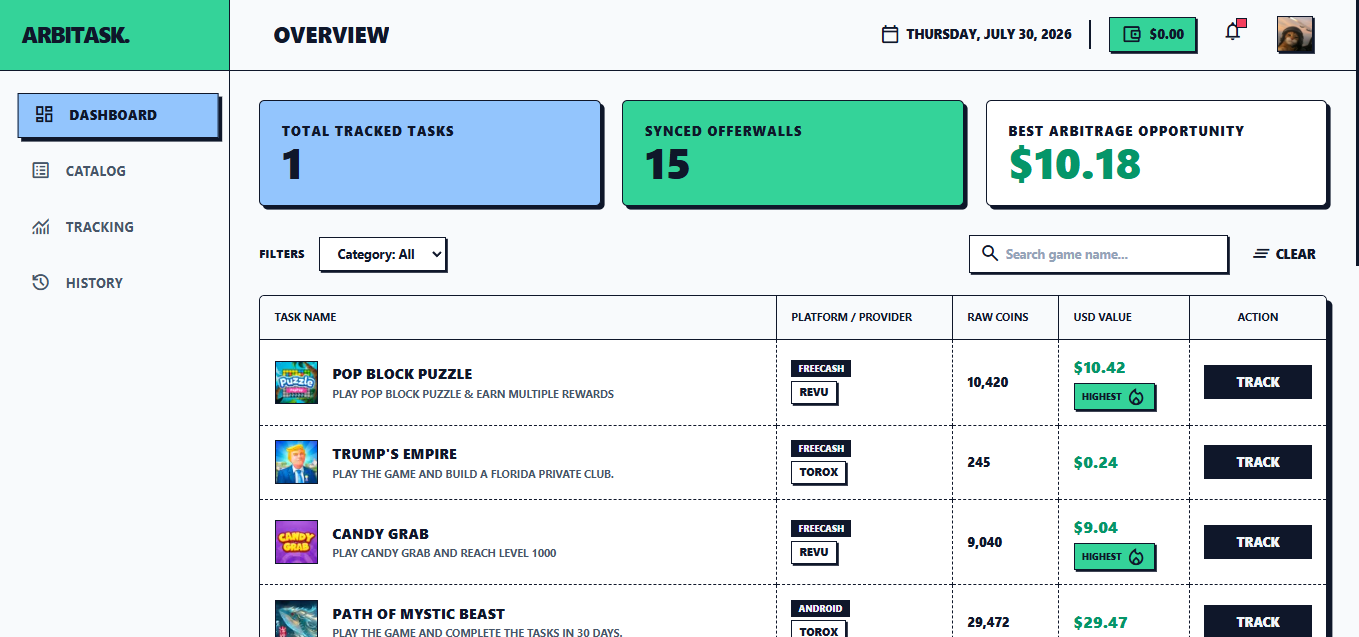
Project / Focus
Arbitask
Category
Systems & Infrastructure
Role
Full-Stack Engineer
Timeline
2026
Arbitask
Multi-Tenant Gamified Tracking Platform
"A secure, scalable web application designed to track gamified tasks and milestones with robust multi-user data isolation."
Project Overview
Arbitask operates as a comprehensive task tracking dashboard integrated with multiple offerwalls. It emphasizes strict data privacy by utilizing a Defense in Depth architecture. The platform combines dynamic Neo-Brutalism aesthetics with complex backend logic, ensuring that each user session is perfectly isolated and transactions are deeply validated.
The Story: Engineering Trust
Background & Vision — Stemming from a requirement to effectively manage, track, and aggregate progress across various Get-Paid-To (GPT) platforms, Arbitask was engineered to organize scattered milestones and automatically calculate potential yields. The goal was to build a secure internal tool that behaves like a fully-fledged SaaS product.
Challenges & Solutions — The critical challenge was implementing strict multi-tenant architecture. With a complex database of tasks, notifications, and user logs, it was imperative that user data never leaked across sessions, while maintaining a seamless, responsive UI. I locked down the system at multiple layers. On the client side, components utilize conditional rendering bound to secure sessions via Auth.js. On the server side, I engineered Next.js Server Actions with rigorous Prisma ORM query filters, explicitly validating user email relations for every single database read, write, and deletion.
Arbitask stands as a testament to the importance of security and architectural integrity. It proves the capability of building a robust, production-ready system utilizing the cutting-edge features of the modern React ecosystem.